The Titanic Experiments
These experiments explore evolutionary algorithms as an alternative to gradient-based training of neural networks, using the Titanic Kaggle Dataset. The challenge is a classic binary classification problem: predicting whether a passenger survived the Titanic disaster based on several features.
The dataset includes structured data points such as age, sex, ticket fare, passenger class, number of siblings/spouses aboard, number of parents/children aboard, and port of embarkation. Labels indicate survival (1) or death (0). The full dataset and competition details are available here on Kaggle.
Would you survive the Titanic?
I decided to go ahead and export the model I trained locally so you can input your own Titanic passenger data into the model and see if it thinks that passenger would've survived the Titanic disaster!
I chose to evaluate my neural networks using Q-values instead of accuracy because I wasn’t trying to predict a correct label — I was trying to train agents to learn optimal behaviors over time, and Q-values reflect how valuable each decision is in the long run, not just whether it was “right” in the moment. Even if the shapes of the Q-value and accuracy curves mirror each other, the Q-value gives a smoother, more sensitive view of learning progress, especially when improvements are subtle or when the agent is still exploring. For me, it felt more informative than a flat accuracy metric that doesn't tell the whole story.
Particle Swarm Optimization (PSO)
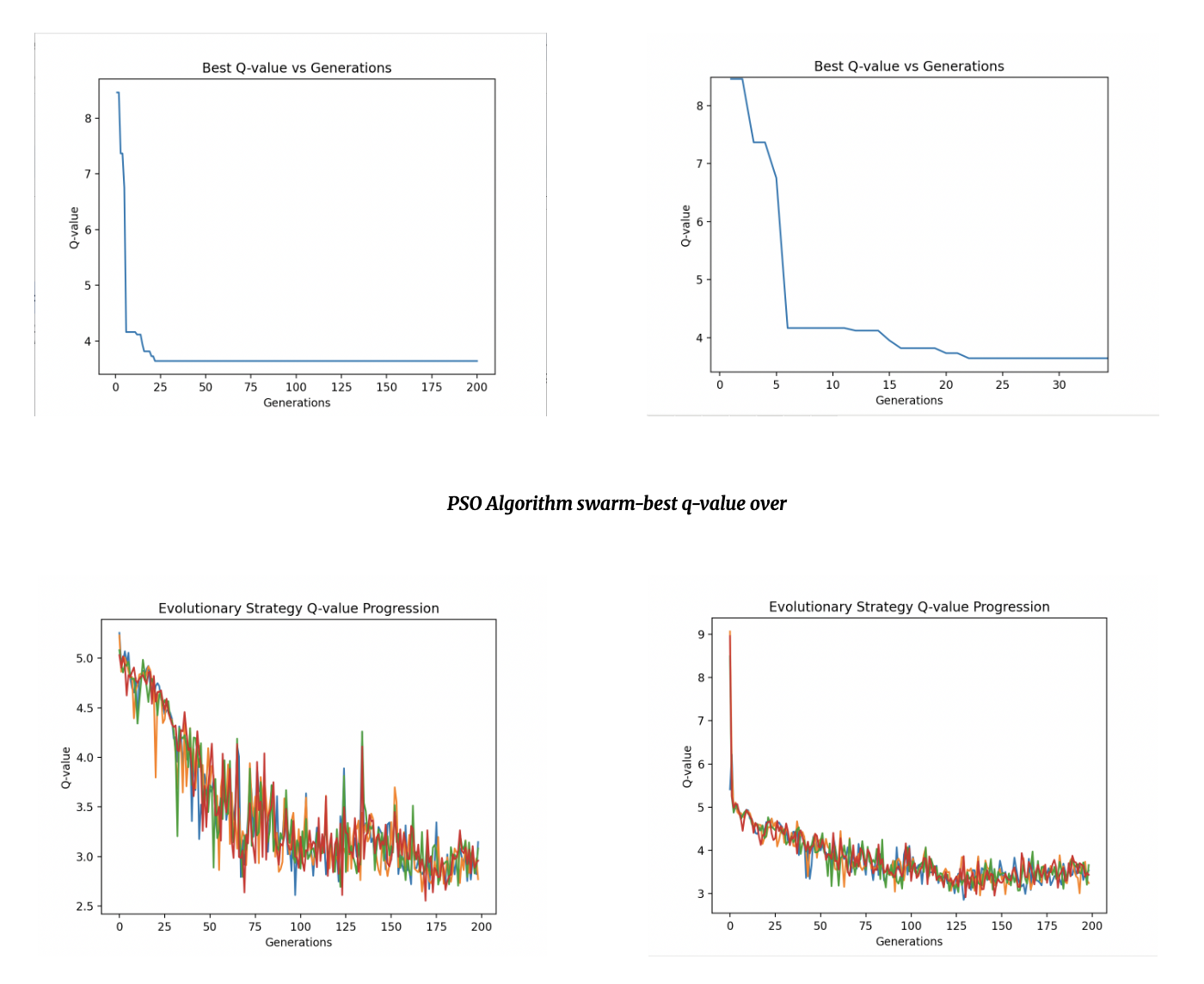
In this approach, each neural network is treated as a particle flying through a high-dimensional space of weights. These particles adjust their position based on both their own best-known performance and that of their neighbors. Over iterations, the population “swarms” toward better solutions. PSO proved especially useful for quickly finding reasonable accuracy without fine-tuning learning rates or gradients.
PSO was the least consistent of the three, but it was the most exploratory, with strong exploration and a tendency to avoid premature convergence. Here's a link to the code.
Differential Evolution (DE)
DE evolves solutions by selecting three random candidates, combining them to form a mutation vector, and then deciding whether to replace the current candidate based on performance. In the Titanic experiments, DE produced slow but stable improvement over generations, with strong exploration and a tendency to avoid premature convergence.
Evolutionary Strategies (ES)
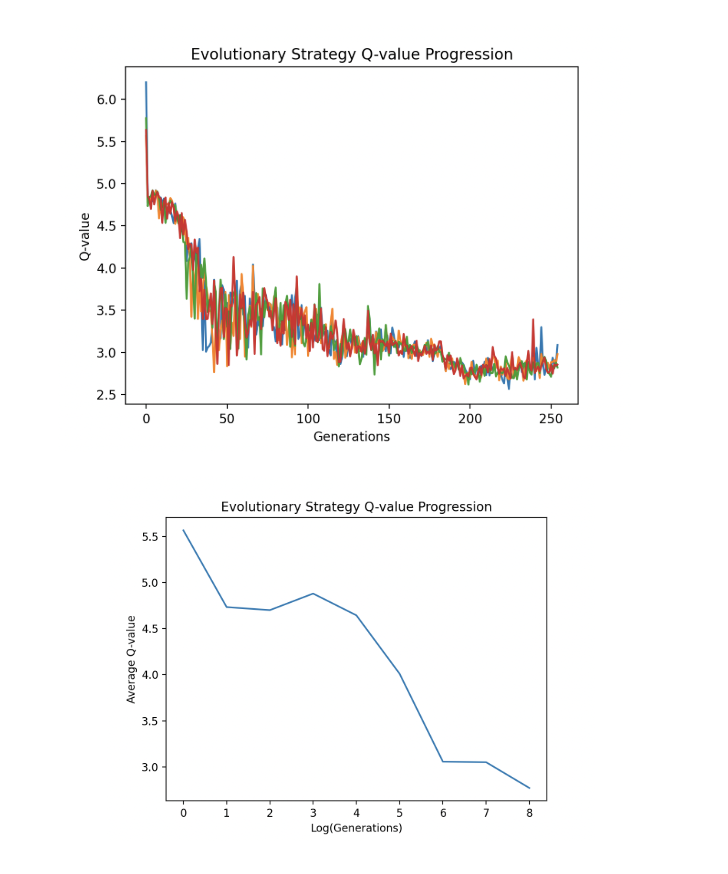
Evolutionary Strategies operate by perturbing neural network weights with random noise and measuring how performance changes. The best-performing variants are selected and used to guide the next generation. ES was the most consistent of the three, striking a balance between exploration and exploitation, and yielding solid validation scores across multiple runs.